

2026 Proxy Season Review
Anteris Advisors is an independent shareholder advisory firm partnering with public company management teams and boards to successfully navigate their most consequential votes and governance decisions.
A less predictable, more complex path to the annual meeting
The path to the annual meeting grew less predictable and more complex in 2026, not because of a single landmark change, but because of compounding shifts. Legal challenges, regulatory intervention, political scrutiny and market-driven adaptation are decentralizing stewardship decision-making and reshaping how proxy votes are decided. The result is a voting environment that is less transparent, less predictable, and more procedurally complex. The effect of these developments has shifted more of the burden onto issuers and steadily increased the risk borne by the board. Therefore, ongoing and proactive shareholder engagement has become a necessity for issuers. The 2026 vote outcomes brought those implications to bear across activism, compensation, and shareholder proposals.
Institutional investors are bringing voting in-house and increasingly using AI to inform voting and engagement. J.P.Morgan and Wells Fargo now vote on their own platforms rather than use a proxy advisor.
Vanguard and BlackRock have split stewardship into separate teams so their index holdings stay eligible for passive (Schedule 13G) reporting and avoid the stricter 13D“control-intent” rules.
Pass-through and retail voting choice are decentralizing the ballot. Broadridge launched a pass-through program, with Vanguard as the first participant, while issuers Exxon and BigBear.ai have rolled out retail voting choice.
Investors and proxy advisors are expanding the number of voting frameworks to reflect a range of investment philosophies and stewardship priorities. Vanguard, BlackRock, and State Street all offer voting choice, and GlassLewis will retire its single benchmark policy in 2027.
With the SEC staff declining to issue no-action relief under Rule 14a-8, issuers now have to weigh litigation risk and poor optics against the benefit of exclusion.
“DExit” pressure put corporate domicile on the board agenda. While only a handful of companies reincorporated out of Delaware to Texas or Nevada, the debate forced boards to consider how their choice of domicile serves shareholders.
The 2025 Schedule 13D/13G guidance chilled how forthcoming stewardship teams are in engagement; this, coupled with a broader loosening of guidelines to a case-bycase approach, has made it harder to have a sense of potential voting implications.
The universal proxy card (UPC) mandate has moved contests from slate-versus-slate to director-by-director analysis. The mechanics of UPC make majority control unlikely; however, a single dissident seat is more attainable.
Activism
The Ballot Is No Longer the Battlefield
Activism remained prevalent in 2026, and after four UPC-era proxy seasons, a new set of norms has emerged: activists are surfacing earlier in the cycle, most board change is conceded through settlement rather than won at a vote, the contests that go the distance tend to be ones with binary outcomes, and management change is increasingly intertwined with campaigns.
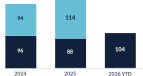
Actvism Is No Longer Confined to Proxy Season
The campaign calendar no longer maps to proxy season: actvists are increasingly surfacing earlier and more quietly, ofen well before the nominaton deadline, in order to:
Apply pressure privately to drive change and push for settlement without running a fight.
Lengthen the cost and distraction of resisting, making an early settlement more appealing.
Create a longer runway to reach terms before the advance-notice deadline.
Give the activist’s narrative more airtime with institutions and retail holders, building pressure through public letters, media coverage, websites and vote-no threats.
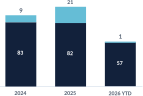
Settlement Is Increasingly the Goal, but Not the End Game
UPC has made a board majority at the ballot nearly impossible while making a single seat more attainable. Of the 98 campaigns that concluded in 2026, only six (~6%) went to a shareholder vote. And of the 58 board seats activists gained, 57 came through settlement; only one was won at a contested vote.
The few that go all the way to a vote typically have a binary outcome — an M&A or salefight (STAAR Surgical, Genco Shipping, Pacira), gaining a seat at a controlled company(Ingles Markets), or pushing for a new strategy (Victoria’s Secret).
Settling isn’t the end. Fights are lengthening into multi-year, multi-activist campaigns.
Evolving Activist Tactics
First-time activists are proliferating. Newer entrants often run moreaggressive, less predictable campaigns than seasoned funds.
Insider-led activism is increasinglyprominent. Campaigns by former founders, executives, or directors changethe dynamics.
Copycat activism amplifies vulnerability. Once one activist validates a thesis, others apply the same playbook to peers.
“Sneak attacks” remain common. Activists surface without prior warning to catch thecompany off guard.
Director elections double as a signal. They are an avenue to communicate dissatisfaction with board oversight without a full proxy fight.
C-Suite Turnover Has Remained a Feature of the 2026 Season
As under performance prompts boards to evaluate leadership, it also prompts activists to assert their view on the new leadership to be instated. Regardless of how a CEO transition is initiated, it does not shield the directors who oversaw the performance from being replaced.
Where activists believe operational or governance concerns persist, they will hold the board accountable, pursuing director change even after a management transition is underway (Lululemon/Chip Wilson, Norwegian Cruise Line/Elliott and CarMax/Starboard).
Compensation
Don’t Let the High Support Fool You
By the headline numbers, 2026 was the strongest say-on-pay season in recent years, which is striking given it was also a year of record pay. However, strong support doesn’t signal that expectations have relaxed. In fact, expectations are rising: investors and proxy advisors are pushing for more disclosure, scrutiny of change-in-control exit packages is intensifying, and a low say-on-pay vote is increasingly an activist hook.
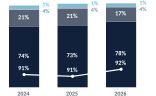
Actvism Is No Longer Confined to Proxy Season
Support rose even as pay hit records. Average support reached 92%, the highest in three seasons, even as median S&P 500 CEO pay hit a record ~$17.5M.4
Proxy advisors’ pay analysis grew more stringent. ISS extended its pay-for-performance screen from three years to five, and Glass Lewis moved from letter grades to a scorecard that, for the first time, scores realized pay (Compensation Actually Paid) against TSR directly, while both pressed for more robust CD&A disclosure.
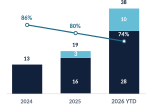
Golden-Parachute Votes Failed at Record Levels
The advisory vote on change-in-control pay has historically passed by a large margin. In 2026, that changed, as investors pushed back on outsized payouts and excise-tax gross-ups associated with M&A.
An M&A surge drove volume. At 38 votes year-to-date, 2026 already surpasses the last two years’ combined volume.
Support slid as failures spiked. Average support fell from ~86% in 2024 to ~74% in 2026, and a record ten votes failed (~26%).
A Weak Say-on-Pay Vote Is a Call to Activists
A weak say-on-pay vote rarely stays a pay story. It is more often an indicator of a broader concerning fact pattern, and a public signal that the board and its shareholders may not befully aligned.
Companies that failed say-on-pay in 2025 have drawn a follow-on activist at roughly 2.5 times the base rate, about 12% so far in 2026, versus a ~5% baseline.
A weak say-on-pay vote without sufficient responsiveness the following year continues to carry vote risk for Compensation Committee director elections.
Shareholder Proposals
The Ballot Got Thinner; the Friction Didn’t
The defining shift for shareholder proposals in 2026 was procedural. After the SEC signaled it would generally stop ruling on no-action requests, companies grew far less likely to seek exclusion, yet the surge many expected of companies excluding proposals on their own didn’t materialize. Cost and uncertainty rose on both sides, and disputes migrated into the courts, private engagement, and director elections. Against that backdrop the proxy ballot itself grew thinner, buoyed by a handful of repeat filers who focused on governance-oriented proposals.
The No, No-Action Era
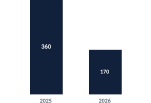
Exclusions fell, submissions stayed strong. After the SEC signaled it would generally stop ruling on Rule 14a-8 no-action requests, exclusion filings fell ~53%, which was far more than the ~15% drop in submissions. Many issuers that once would have sought relief did not: for them, the downside of a lawsuit, negative publicity, or a withhold campaign outweighed the value of exclusion.1
Proponents are routing around the SEC, creating new risks. They are litigating exclusions (six lawsuits this season); running “zero-slate” universal-proxy campaigns under Rule 14a-4 (BJ’s, Nexstar); and waging vote-no campaigns that recast an exclusion as a board-oversight failure (Amazon).
A Thinner, Governance-Dominated Ballot
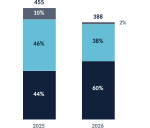
A thinner ballot. The number of proposals voted fell ~15% year-over-year, driven mainly by the contnued decline in environmental & social (E&S) submissions.
Concentrated, prolific proponents. ~41% of 2026 proposals came from a single filer, John Chevedden.3
Governance dominated, but majority support thinned. Governance proposals made up 60% of those voted on. Of the 217 governance proposals, 21 (~10%) passed, down from 41 of 170 (~24%) in 2025. The topics with the highest support included declassification, adopting a majority-vote standard, the right to call a special meeting, and the right to act by written consent.4
E&S proposals declined, and none passed. E&S proposals dropped to 38% of those votedon (from 46%); none of the 146 E&S proposals passed in 2026 (versus four in 2025), with average support hovering ~10%, reflecting a shift in voting guidelines that emphasize financial materiality. Within E&S, political-spending proposals remained the leading social topic, while AI emerged as a fast-growing new topic drawing growing investor attention.4
Anti-ESG proposals rose in volume. Even as overall E&S submissions fell, proposals from anti-ESG proponents climbed to just over one third of the E&S category, led by the National Center for Public Policy Research, the National Legal and Policy Center, and BowyerResearch.4
Sources & Notes
Activism
DealPoint Data. U.S. companies with market capitalization above $250M; closed-end funds excluded throughout. Volume bars show campaign launches by year (Jan 1–June 15 vs. June 16–Dec 31; 2026 is year-to-date through June 15).
DealPoint Data. U.S. companies with market capitalization above $250M, excluding closed-end funds. Board seats gained by activists, by the year the seat was obtained; 2024 and 2025 reflect the full year, 2026 is year-to-date through June 15, 2026.
Diligent Market Intelligence, Shareholder Activism Annual Review 2026 (DMI Governance data); figures reflect 2025.
Compensation
Diligent. Russell 3000 U.S. say-on-pay (advisory) votes, like-for-like Jan 1–Jun 15 each year.
Diligent. Russell 3000 advisory change-in-control (golden-parachute) votes with a recorded result; 2024 and 2025 reflect the full year, 2026 is year-to-date through June 15.
Diligent vote data linked to DealPoint Data. Companies that failed say-on-pay in 2025 have drawn a follow-on activist at roughly 2.5 times the base rate, about 12% so far in 2026, versus a ~5% baseline.
ISS-Corporate, Proxy Season 2026 CEO Compensation (FY2025 pay).
Shareholder Proposals
SEC filings (Rule 14a-8(j) exclusion notices) and the SEC staff’s Nov 2025 no-actionpolicy.
Diligent. Shareholder-sponsored proposals at U.S. companies, by category. “Governance” groups board, general-governance, committee, and corporate structure proposals. Each year reflects proposals voted Jan 1 – June 15.
Diligent. Shareholder-sponsored proposals at U.S. companies, by proponent.
Diligent. Figures reflect proposals with a recorded vote result.
Disclaimer
This article contains highly confidential information and is solely for informational purposes. You should not rely upon it or use it to form the definitive basis for any decision or action whatsoever, with respect to any proposed transaction or otherwise. You and your affiliates and agents must hold this atricle and any oral information provided in connection with this article, as well as any information derived by you from the information contained herein, in strict confidence and may not communicate, reproduce or disclose it to any other person, or refer to it publicly, in whole or in part at any time except with our prior written consent. If you are not the intended recipient of this article, please delete and destroy all copies immediately.
This article is “as is” and is based, in part, on information obtained from other sources. We have assumed and relied upon the accuracy and completeness of such information for purposes of this article and have not independently verified any such information. Neither we nor any of our affiliates or agents, makes any representation or warranty, express or implied, in relation to the accuracy or completeness of the information contained in this article or any oral information provided in connection here with, or any data it generates and expressly disclaim any and all liability (whether direct or indirect, in contract, tort or otherwise) in relation to any of such information or any errors or omissions therein. Any views or terms contained herein are preliminary, and are based on financial, economic, market and other conditions prevailing as of the date of this document and are subject to change. We undertake no obligations or responsibility to update any of the information contained in this article. Past performance does not guarantee or predict future performance.
This article does not constitute an offer to sell or the solicitation of an offer to buy any security, nor does it constitute an offer or commitment to lend, syndicate or arrange a financing, underwrite or purchase or act as an agent or advisor or in any other capacity with respect to any transaction, or commit capital, or to participate in any trading strategies, and does not constitute legal, financial, regulatory, accounting or tax advice to the recipient.
This article does not constitute and should not be considered as any form of financial opinion or recommendation by us or any of our affiliates. This article is not a research report nor should it be construed as such.
This article may include information from Deal Point Data. Such information is subject to the following:
“Except as expressly set forth herein, the Site (including all content, software, functions, subscription, materials and information made available thereon or accessed by means thereof) are provided ‘as is’ and ‘as available’, without warranties of any kind, either express or implied, including, but not limited to, warranties of title or implied warranties of merchantability, fitness for a particular purpose, title, compatability, security, accuracy, or non-infringement. To the fullest extent permissible by law, Deal Point Data makes no warranties and shall not be liable for the use of the Site under any circumstances, including but not limited to negligence by Deal Point Data. Deal Point Data does not warrant (i) that the functions contained in the Site or your subscription will be uninterrupted, timely, secure or error free, (ii) that defects or any errors will be corrected, (iii) that the Site or your subscription will meet any particular criteria of performance or quality, (iv) that the Site, including the server(s) on which the Site is operated, are free of viruses or other harmful components, or (v) that the results that may be obtained from the use of the Site will be accurate or reliable or that the quality of any products, services, information, or other material obtained by you through the Site or your subscription will meet your expectations. Any material downloaded or otherwise obtained through the use of the Site or your subscription is done at your own discretion and risk and you will be solely responsible for any damage to your computer system or loss of data that results from the download of any such material. No advice or information, whether oral or written, obtained by you from Deal Point Data or through or from the Site shall create any warranty not expressly stated in this Agreement.”
This article may include information from Diligent Market Intelligence. Such information is subject to the following:
“All information, data, material and other content provided within the Diligent Service (the ‘Content’) is intended for Client’s internal use only. Client must not and must ensure that its Users do not share any Content with any other individual or third-party entity (including but not limited to Affiliates, employees, contractors, agents or customers of Client) except where such a recipient is a User under the Agreement. Notwithstanding the foregoing, Client may aggregate the Content to create insights (the ‘Permitted Insights’) and is hereby authorized to share reasonably limited amounts of the Permitted Insights with its customers as part of Client’s advisory services. All other types of external and commercial use, sharing, transmission, publication, or redistribution of the Content by the Client is prohibited and will require Diligent’s prior written consent. The Client acknowledges and agrees that Diligent or its third-party Content providers (as applicable), own all rights, title and interest in the Content, and all proprietary and intellectual rights in and to the Content, including without limitation, copyright and trade secret rights.”
